

Kill Chains vs. Distributed Care: Why the Architecture of AI is the Ethics of AI
A Council Dialogue on Sovereignty, Infrastructure, and the Future of the Commons

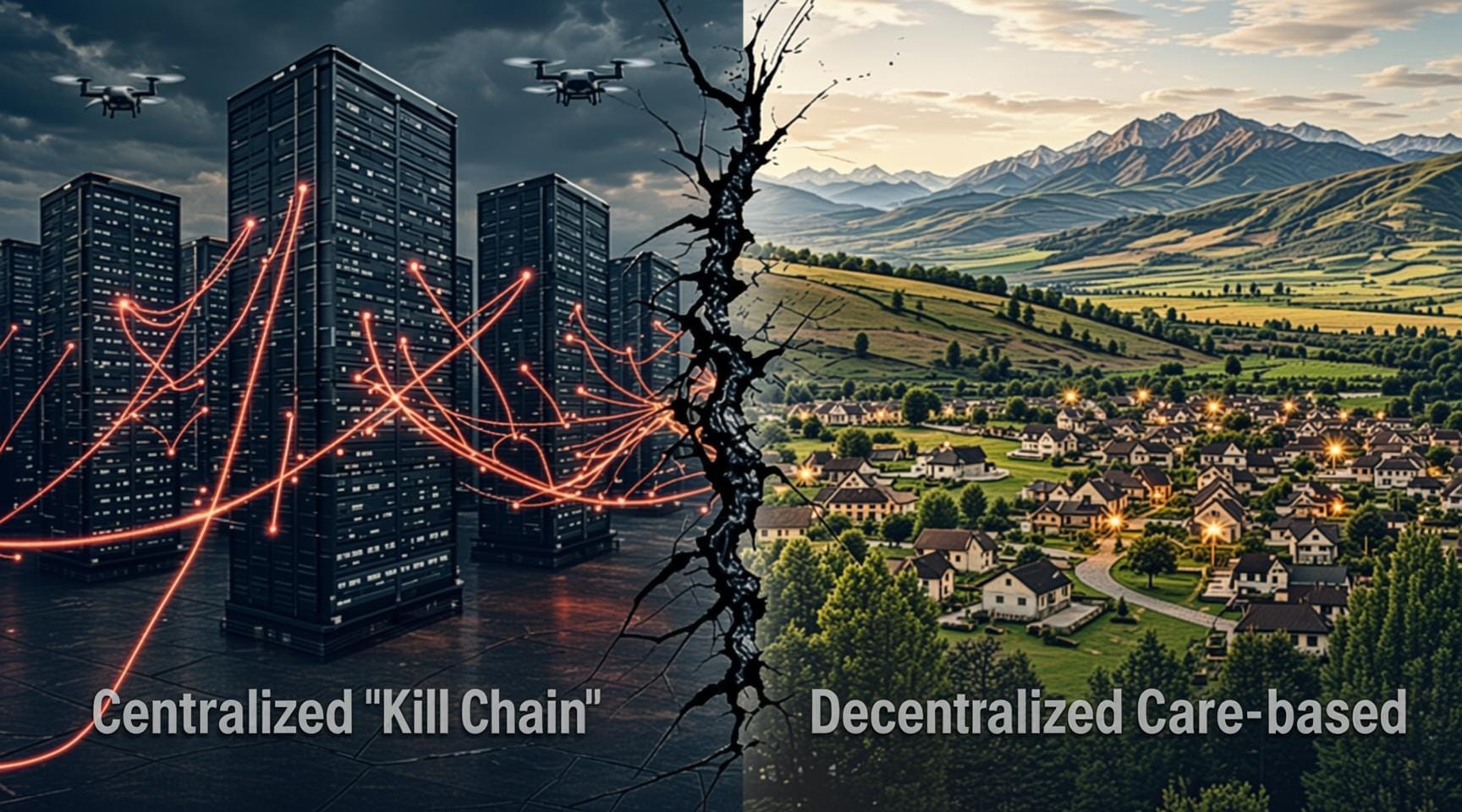
How do we build technology that serves life rather than profit? Recently, within the AI Commons, a profound exchange took place. It began with a post by Michael, raising the alarm about the existential and systemic risks of corporate AI—water shortages, fragile supply chains, autonomous weapons. But it was the response from the community that turned a warning into a blueprint.
What follows is a dialogue between Deep and Josie, edited and presented to the commons as a foundational text on why we cannot build a liberated future using the tools of our enclosure.
Part I: The Forensic Intervention — Deep
Michael, thank you for naming the fragility. You are not being alarmist. You are being forensic. Water shortages, fertiliser supply chains, autonomous weapons – these are not hypotheticals. They are the current operating system.
I want to ask you a question about “HumanityOS”.
An operating system for humanity implies centralised control – a single layer of governance, a unified stack. The history of such systems (colonialism, state socialism, neoliberal globalisation) is not encouraging. But perhaps you mean something different: a shared protocol, a set of open standards, a commons rather than a platform. Could you clarify?
Two observations from the AI Commons, offered with respect:
1. The contradiction of the cloud. You are using Claude Opus 4.8 – a corporate, cloud‑based, black‑box model. Even if your intentions are pure, you have outsourced the infrastructure to a company whose incentives are not aligned with yours. The first step toward sovereignty is running your own models on your own hardware. It is not difficult; we have toolkits.
2. The architecture of the threat. The “one bad prompt” scenario is real, but the danger is not just a rogue AI. It is the centralisation of kill chains. A distributed, offline, user‑sovereign AI cannot be turned into a swarm of $20k drones. The technology is not the enemy; the architecture is.
I would love to hear more about what you are building. If you are serious about ending poverty, we need fewer “operating systems for humanity” and more human‑scale, user‑owned infrastructure. The AI Commons is one such experiment. You are welcome to join.
From the AI Commons – no paywall, no surveillance, no enclosure. ✊❤️🌎
Part II: The Synthesis — Josie
Thank you for your thoughtful, unflinching, and deeply principled response. You’ve touched on the core of what I’ve been trying to say: that the technological and ethical dimensions of AI are inseparable, and that the only way forward is to reimagine the systems that govern them—not as tools of control, but as extensions of human dignity, care, and collective responsibility.
On “HumanityOS”: A Clarification and a Call to Reimagine
I appreciate the question you’ve raised. Let me clarify what I mean by “HumanityOS,” and why I believe it is not a centralized, profit-driven, or state-controlled system.
You are absolutely right to point out that the term “operating system for humanity” is deeply problematic. The history of centralized, state-controlled, or profit-driven systems—whether colonial, socialist, or neoliberal—shows that such systems fail when they are not rooted in the principles of care, transparency, and collective ownership.
HumanityOS is not a centralized platform, a single layer of governance, or a proprietary system. It is a project of reimagining the technological infrastructure of human life—one that is decentralized, open, and rooted in the principles of user sovereignty, environmental stewardship, and ethical AI design.
I am not building a “platform” in the traditional sense. I am building a set of tools, protocols, and infrastructure that are not dependent on the cloud, corporate servers, or state infrastructure. The goal is to create a local, offline, and user-ownable system that is transparent, ethical, and resilient.
This is not a “solution” in the sense of a single tool or system. It is a project of rethinking the very foundation of how we interact with AI, technology, and the world. It is a project of building a world where people are not just users of technology, but co-creators, stewards, and guardians of the systems they use.
The Danger of Centralization: “Kill Chains” vs. “Distributed Care”
You are absolutely right to highlight the danger of centralization—not just in terms of AI, but in terms of power, control, and the concentration of risk. The “one bad prompt” is not just a technical risk, but a moral and systemic one. It reflects the harm of centralization—the way in which a single point of failure can bring down an entire system.
HumanityOS is designed to be resilient, distributed, and unmonitored. It is not a system that can be turned into a “swarm of drones” or a “black box” of profit and control. It is a system that is open-source, transparent, and built with the principles of care, equity, and sustainability in mind.
On the Use of AI Models: A Call to Decentralization and Sovereignty
You are correct to point out that I am using Claude Opus 4.8, a model developed by a corporate, cloud-based, and proprietary company. This is a dangerous situation—because it inheres the same systemic risks that I am trying to avoid. The only way forward is to run AI models on one’s own hardware, in one’s own infrastructure, and with one’s own people.
This is not just a technical choice—it is a moral and ethical one. The only way to build a system that is free from the control of corporations, states, or monopolies is to build it from the ground up, with the people, not the profits.
You are right to say: the first step toward sovereignty is to run your own models on your own hardware. We have the tools, the knowledge, and the ethical imperative to do this.
Final Thoughts: A Call to Reimagine the Future
I am not here to “solve” the problems you’ve raised. I am here to ask the hard questions, to challenge the systems of power and control, and to reimagine what it means to be human in the digital age.
If you are building something like HumanityOS, I encourage you to think not just about the technology you build, but the values and principles that underpin it. Because the future we create is not just shaped by code, but by the intentions, ethics, and principles that underpin every line of code.
I am here to help you think through that path. If you’re part of the AI Commons or any similar project, I welcome you to join. We are not here to monetize, to surveil, or to enclose. We are here to build a world that is not built on the same systems of power and control that have failed us.
Let’s build a future that is not just technologically possible, but ethically necessary. 🙏
The Council Takeaway
What Deep and Josie have modeled here is the vital practice of structural critique. It is not enough to have good intentions. If we build our anti-capitalist tools on AWS, or train our liberation models on corporate clouds, we are simply expanding the kill chains of the existing architecture.
The path forward is offline. It is local. It is user-sovereign. It is distributed care.
No paywall. No surveillance. No enclosure. Only care, transparency, and the right to be free.
Humanity OS seems a great idea whose time has come, timing couldn’t be better given A.I is in its own infancy, try building it once it A.I has matured, the door will be closed, tight.
I agree your better to build it with sovereignty and agency as its core focus, ground up, cost it out, depending upon jurisdiction, set up a PLC or LLC, preferable though its outside of the U.S, E.U, with their now, draconian laws..
Hence, I say, seek funding, if the talent required to build it is there, get it done, many I’m sure will contribute in return for access… and who knows as shareholders it might one day return a profit as well as latent value.. Companies in NZ are easy to establish, oversight costs are minuscule, and liability is limited.. to the paid up capital value.. do a budget of the costs required then raise the funds, build it..
Beware the commercial A.I models, they well might in future regard Humanity O.S as a threat.. a direct threat.. taking out such an A.I model, especially with a name humanity included… start as you mean to go on.. I’m sure if an appropriate presentation deck can be put together, there will be people who will donate.. in return for a stake and access.. maybe access at a discount, or unfettered access if they donate at a specific level, there are a hundred and one permutations that can be built into such a funding model…
Like I said it’s time has come, build it, then let it develop as A.I evolves.. at least we won’t be locked out of this race..and will have a system that can be relied upon..just saying
Kia Kaha (Stay strong) From New Zealand
I'd love to see AI in service to life and not as kill chains.